True Love Calculator
Enter two names and discover your love score instantly.
For entertainment purposes only — real love is built, not calculated. 💕
True Love Calculator
What Is A True Love Calculator?
I’ll be honest — the first time I plugged two names into one of these, I expected nothing more than a gimmick. Turns out it’s grown into something people actually return to for reflection, not just a throwaway internet experience. At its core, this is numerology dressed for the modern era: you submit a name, then a partner’s name, and the tool reads the letters like a fingerprint of your inner energetic pattern. Long before anyone typed a query into a search bar, people consulted doctor love types and local mystics for the same answer — whether a bond has real staying power. Today the Internet just does it faster. What you’re really testing isn’t visual chemistry or physical traits; it’s whether personality, heart, and energies line up well enough to sustain a relationship. Some tools lean on zodiac signs, others purely on letters, but the promise is the same — a percentage that claims, sometimes with more confidence than it deserves, to expose your compatibility and hint at your soulmate’s readiness.
What Does Your Love Score / Percentage Mean?
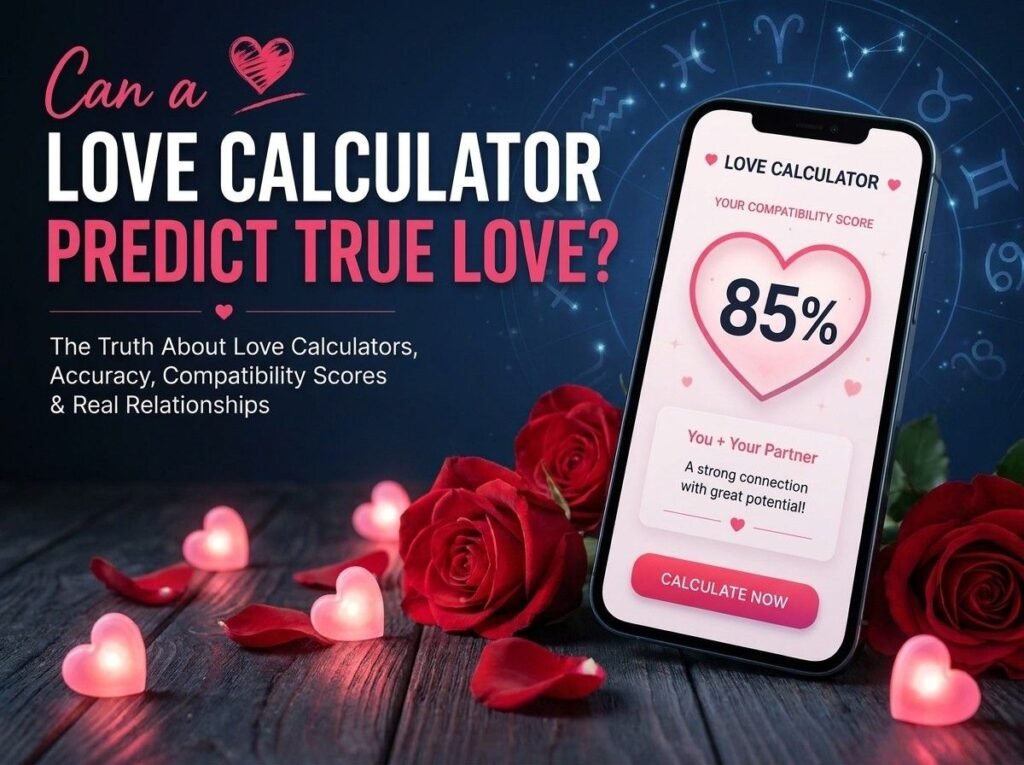
People panic over the number before they understand what it’s pointing at. A 100% doesn’t mean destiny sealed — it means the pattern recognition found unusually strong resonance, nothing more. I’ve seen users get a 41% and assume the worst, when really that number is just flagging an emotional disconnect that better communication could close. Sit around 60% or 61%, and you’re looking at friendship-grade trust rather than romantic fireworks — not a bad thing, just a different starting point. Scores near 75%, 78%, even a surprising 70% between people who seemingly clash, often point to fire and water elements balancing each other out in ways logic wouldn’t predict. Land exactly on 50%, and the tool is telling you that your mental level and their deep inner thoughts are roughly matched — workable, but requiring patience. Even a low 12% or 21% isn’t a verdict; it’s a nudge toward the weakness both partners need to address if long-lasting success is the goal.
How Does The Love Calculator Work?
Strip away the mysticism and it’s genuinely just three steps. Type your name into the first box — the software reads it as a personal character signature. Second, enter your partner’s details so the system can decode their letters the same way. Third, hit the button and let the numerics merge both readings into one combined score. Some versions add birth details, aligning them with celestial planets to sharpen the personality read before the final relationship prediction appears. It’s marketed as mathematical science layered over an old idea — that names carry hidden energetic frequencies — and whether or not you buy that premise, the mechanics are simple enough that anyone can run the test in under a minute. What surprised me most when I started testing this stuff wasn’t the accuracy; it was how consistently the same name pairs produced the same result, which tells you it’s pattern-based rather than random.
Why Use A Love Calculator? / Benefits
Here’s the angle most people miss: this isn’t really about predicting romance, it’s about giving two people a low-pressure reason to talk. I’ve watched couples use a shared result as a conversation starter that would’ve felt awkward without it. The benefit isn’t the accuracy of the love percentage — it’s the emotional curiosity it sparks without demanding anything serious. Because it’s low effort and high insight, it works as an early spark check before people invest real feelings into an interpersonal connection. Shareable results build mutual trust when couples generate them together, and the dialogue that follows often matters more than the digits themselves. For pure entertainment, few tools deliver instant clarity this efficiently — you type two names, and within seconds you have something to laugh about, argue about, or reflect on, which is exactly the kind of lighthearted self-discovery this format was built for.
Is The True Love Calculator Accurate?
Ask ten people this question and you’ll get ten different answers, and that inconsistency is actually the honest answer. It’s not strictly scientific — it can’t be, given it studies energetic patterns rather than measurable behavior. What it does offer is a cosmic glimpse that satisfies human curiosity about a relationship’s potential without claiming certainty. I’ve found some users treat the result as surprisingly true to their lived experience, while others dismiss the whole exercise as an entertaining game that just happens to spark good conversation. Both reactions are valid because the calculator was never built to replace the intuition sitting in your own heart. It bridges ancient mystical tradition with a very modern itch to quantify feelings, and that bridge is interesting precisely because it doesn’t need to be accurate to be useful — it just needs to prompt reflection on the emotional connection you already sense.
Key Factors In Love Compatibility
Four things actually drive the final combined score, and most people only clock one of them. First is the numeric energy pattern buried in your name — the raw numerology translation. Second is personality: sensitivity, kindness, confidence, and how those traits merge when two people share space. Third, and probably the most underrated, is the depth of emotional response — how your emotional alignment reacts under pressure, not just in calm moments. Fourth is long-term potential, which relies on subtler signals of shared human energy rather than a single static reading. None of these factors work in isolation; a calculator that ignored one would just be guessing. When I explain this to skeptics, I frame it less like magic and more like a checklist — the kind you’d use to spot where a relationship’s foundation might need reinforcement before bigger cracks appear.
What Makes A True Soulmate?
Forget the fireworks — a real soulmate feels like relief. It’s the person whose presence is comforting rather than exciting in a way that keeps you on edge. Shared values matter more than shared hobbies; when your life priorities and personalities genuinely match, even silence between you carries weight instead of awkwardness. This kind of harmony changes daily existence because it becomes a buffer against everything chaotic happening outside the relationship. Recognizing this person rarely happens on schedule — it tends to arrive when you’ve stopped actively searching, which is its own kind of proof. But finding it isn’t the finish line. A soulmate connection still needs ongoing care, continuous emotional growth, and ongoing dedication from both people, or the rare bond quietly erodes. I’d argue the “soulmate” label gets used too casually online — the real version requires far more upkeep than the word implies.
Signs You Have Found Your True Love
No dramatic music, no perfect timing — real love usually looks quieter than fiction promises. You’ll notice it in the absence of anxiety: you feel secure instead of unsure, and you stop performing a version of yourself for approval. Disagreements happen, sure, but mutual respect survives them, and you never feel threatened during a quiet or awkward pause. Over time this steadies into genuine trust, and the relationship starts generating long-term happiness rather than short bursts of excitement. Both people actively support each other’s ambitions, which turns the connection into something that keeps expanding rather than plateauing. You’ll also catch yourself prioritizing their well-being right alongside your own without resentment — that shift is one of the clearest signals available. When life gets turbulent, this relationship becomes the safe harbor, not another source of stress, and that alone gives you courage you didn’t have solo.
Pros And Cons
On the upside, it’s an instant, user-friendly way to generate a love percentage for lighthearted entertainment, and the shareable results travel well across social platforms as conversation starters. That’s the appeal in a nutshell. The downside is just as real: it leans on a narrow set of factors, so calling it scientifically accurate would be misleading, and people chasing serious romantic guidance can easily misread a playful number as a verdict. There’s also a privacy angle worth remembering — protect your personal data and stick to reputable platforms, since not every version of this tool handles information responsibly. My take after testing plenty of these: enjoy the fun without letting the score set your expectations. Treat it as a mood-lifter, not a diagnostic, and you’ll get everything good out of it without inheriting the drawbacks that come from taking it too seriously.
How Accurate Is This Love Calculator? See The Examples
Running odd pairings through these tools is honestly half the fun. Famous name combinations sometimes produce scores nobody would predict from logic alone — a widely known political couple scoring a startling 90%, while an entirely different power couple lands at 96%. Meanwhile, a well-known former president and first lady pairing shows wildly varying results depending on which version of the tool you use. Test something absurd, like a dog and a duck, and you might get a mere 4%, which says everything about the playful, non-scientific nature of the whole exercise. Certain historical political rivals dropped to 22%, and some random pairings even sank to 12%. None of this proves the algorithm understands real human relationships — it proves it prioritizes letter patterns over logic. That’s not a flaw, honestly; it’s the entire appeal. These wild swings are what keep people coming back to test just one more combination.
Definitions Of Love
Love is a slippery word before you even get to relationships — we use it for a meal we enjoyed and for a person we’d sacrifice everything for, which tells you how elastic the term really is. Psychologists split it into distinct behavioral categories: maternal bonds, sexual attraction, platonic devotion, each with its own emotional signature. Strong affection sits at the base of nearly all of them, which is why the categories overlap more than people expect. Exploring these variations helps explain why our emotional capacity keeps shifting across a lifetime instead of settling once and staying fixed. Whether platonic or romantic, this kind of connection enriches daily life and provides support during hard stretches. I don’t think you can fully define love with one sentence — you can only describe its shapes, and every relationship ends up drawing a slightly different one.
Approaching Love
People chase physical features first and depth second, which is backwards if lasting connection is the actual goal. Real compatibility needs both mind and heart engaged, not just outward attraction doing the initial work. The modern science of romance tries to explain why opposites attract and why preferences shift with age, and some studies even suggest that decision-making criteria vary noticeably across different demographics and life stages. Understanding these patterns helps you notice your own subconscious tendencies before they quietly steer a decision. Every romantic path involves variables nobody can fully predict, and personal history shapes who you gravitate toward more than most people admit. Ultimately, logic can’t fully account for attraction — that mystery is part of what makes it worth pursuing, and trusting your instinct while staying open-minded tends to produce better outcomes than overanalyzing every signal.
Can You Get 100% On A Love Calculator?
Technically, yes — but it’s rare enough that most users never see it. A perfect reading happens only when both numerical energy patterns align almost flawlessly, and it’s usually read as a soulmate-level signal packed with trust and shared joy. Here’s the part people skip past too fast: a lower score isn’t a diagnosis of failure. It just means the connection needs deliberate building rather than assuming it’ll form on its own. Plenty of couples with unremarkable scores build genuinely strong, lasting partnerships because they lean on communication instead of trusting an algorithm to do the emotional labor. Chasing a perfect percentage can actually distract from the ordinary, flawed reality of a real partnership. My honest advice: let the number amuse you, then set it aside — the depth of your bond was never something a digital calculation could fully capture anyway.
Which Planet Is Responsible For Love?
In astrology, Venus takes the credit — it’s the planet tied to beauty, romance, and how we express attraction toward the people we choose. Understanding this kind of planetary influence gives you a framework for why certain individuals pull at you more than others, even when logic can’t explain it. Some people lean heavily on these cosmic patterns to make sense of their own relationship needs, treating the stars as a guide rather than a rulebook. You don’t have to follow astrology closely to find the concept interesting — it’s part of a larger idea that our emotional journeys sit inside something bigger than day-to-day decision-making. Still, the universe only sets the stage. What happens on it — the actual effort of building something lasting — stays entirely in human hands, regardless of where Venus happens to be sitting.
Which Zodiac Pairs Are Soulmates?
Water signs — Cancer, Scorpio, Pisces — tend to sync emotionally without much friction, largely because their shared element makes empathy come naturally rather than forced. Fire signs play differently: an Aries usually finds its best spark next to a bold Leo, both riding similar energy levels. Earth signs like Taurus want something else entirely — stability, loyalty, grounded consistency — and they’ll bond fastest with partners who value the same steadiness. None of this guarantees perfection on its own; a good zodiac pairing without personal effort still stalls out. What these combinations really offer is a map for understanding why two personalities click or clash, which helps couples navigate friction with more patience. The best matches, star signs or not, still come down to respect and honest communication doing the actual heavy lifting.
Do I Need Personal Details To Use The Love Calculator?
No — and that’s precisely why the format has stuck around. A first name on each side is usually enough to generate a fun, surprisingly specific-feeling compatibility score, with no sensitive personal data required. This low barrier is what makes it accessible to basically anyone curious enough to try it, without triggering privacy anxiety. The underlying algorithm only cares about the alphabetical vibration of the letters you submit, so there’s nothing complicated being requested behind the scenes. People appreciate this as a lighthearted break from more serious daily routines, and the simplicity is exactly what keeps the experience approachable instead of intimidating. Since identity isn’t the point, the tool protects your anonymity by design rather than as an afterthought — the focus stays on entertainment, not data collection.
Do I Need To Enter My Full Name In The Love Calculator?
You’ll get a slightly richer read using your full name, since more letters give the algorithm more data to process — but first names alone still work fine for casual testing. I’ve run both versions side by side just to see how much the percentage shifts, and honestly, the variation is part of the appeal. People experiment with nicknames versus formal names purely to watch the numbers fluctuate, and that playful comparison is often more entertaining than the actual score. Whether you use a full legal name or a casual alias, the experience stays equally engaging either way. There’s no wrong input here — the platform accommodates quick, silly tests just as easily as more deliberate ones, so use whichever version satisfies your curiosity in the moment.
Can I Use This Calculator For Anyone?
Absolutely, and that’s where a lot of the entertainment value actually lives. People test crushes, current partners, close friends, coworkers, even celebrity pairings just to see what improbable percentage comes back. The system doesn’t distinguish romantic from platonic — it simply reads the resonance between two names, which means you can just as easily test a sibling or an old classmate as a potential partner. This flexibility is why group settings get so much mileage out of it; someone throws in a ridiculous pairing, everyone laughs, and suddenly there’s a group conversation happening around shared curiosity. There are no restrictions on who qualifies for a test, which turns the tool into something closer to a party game than a serious relationship instrument — and that’s exactly why it keeps getting shared.
Is The True Love Calculator Free?
Here at VeriCalculator, Yes, completely — no registration wall, no hidden charges, no catch buried in the fine print. That accessibility matters more than people give it credit for, because it removes every financial barrier standing between curiosity and actually running the test. Most versions were built purely for public entertainment, which explains why they’ve spread so widely without needing a paywall to justify their existence. Users can run the same names repeatedly, experiment with different combinations, and never worry about a surprise fee showing up later. That open-door approach is part of why the format found such broad appeal in the first place — entertainment shouldn’t require a wallet, and this particular corner of the internet proves that point reliably.
Does The Calculator Store My Data?
A well-built version won’t — the names you type should get processed instantly and then discarded, with nothing logged or shared with third parties. That real-time, no-storage approach matters because testing a crush or a partner’s name is inherently a little personal, even if it feels trivial. The better tools treat that sensitivity seriously, using automatic deletion so your input disappears the moment you close the page. Protecting anonymity isn’t a minor feature here — it’s the thing that lets people actually relax into the experience instead of hesitating before typing a name. If you’re evaluating any version of this tool, that’s the detail worth checking first, because entertainment should never come at the cost of quietly compromised privacy.
Does A Low Love Score Mean The Relationship Won’t Work?
No, and honestly this is the most important thing to understand about the entire format. A low percentage can’t predict failure — it has no access to the mutual understanding, trust, or effort that actually determines whether two people last. I’ve seen couples start with a surprisingly weak score and use it as motivation to communicate better, which is a far more productive reaction than treating the number as fate. The result only reveals a narrow slice of a much larger picture; it can’t measure your genuine capacity for connection or the work you’re both willing to put in. Don’t let an algorithm dictate your mood about a relationship — use it as a playful prompt for conversation, then let your own judgment, not a digital score, decide what happens next.
Leave a Reply