I first noticed the moon soulmate craze while scrolling through TikTok in early 2023, watching thousands, then millions, of couples post side-by-side images claiming their birth moon phases formed a complete Full Moon almost overnight.
Long before astrology apps existed, ancient civilizations tracked lunar positions and planetary positions to explain relationship dynamics between family members, believing moon phase at birth quietly shaped how naturally two souls would bond for centuries.
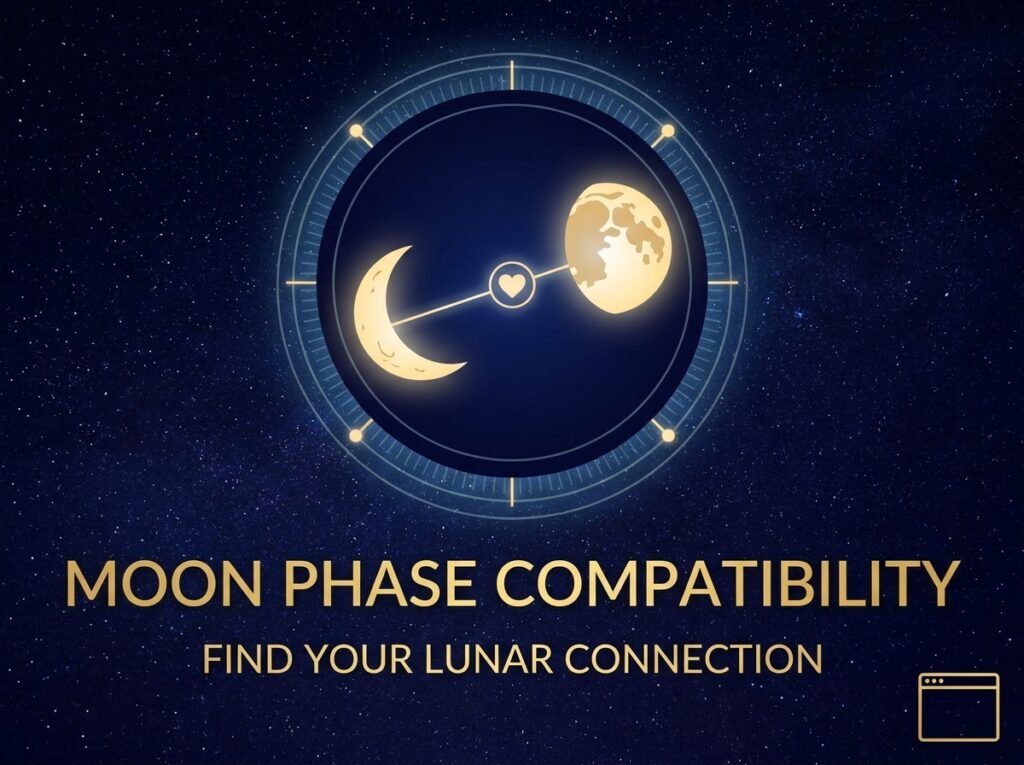
Picture your exact phase glowing on the left and your partner’s on the right side — when a waxing crescent Moon visually combines with its corresponding waning crescent, natural completion forms, a compatibility pattern illumination reveals.
Moon Phase Compatibility Calculator
Enter two birth dates and discover your lunar connection instantly.
As someone who tests relationship tools for a living, I’ll admit the viral trend felt more like fun than science — yet the phenomenon pulled in individuals curious whether emotional resonance between partners could be understood.
Beyond astrology as love prediction, interpretive systems reflect culture — six ranges from Conjunct to Aversion, spanning up to 180 degrees, map emotional energy into a distinct relational dynamic humanity has used to harmonize spiritual curiosity.
How the Moon Phase Compatibility Calculator Works
At the exact moment of birth, our free tool pulls astronomical lunar data to pinpoint Moon’s phase with precision — no guessing, no shortcuts, just a specific moment translated into a percentage anyone instantly understands clearly.
Astronomers actually recognize eight lunar phases — New Moon, Waxing Crescent, First Quarter, Waxing Gibbous, Full Moon, Waning Gibbous, Last Quarter, and Waning Crescent — and everything in between falls somewhere across these eight standard lunar phases.
Once it identifies two natal moon phases, the calculator cross-references them, calculating angular distance between where each moon occupied the sky at birth date, then analyzes compatibility by comparing lunar characteristics side by side closely.
Behind the scenes, the process examines how much of the lunar surface illuminated at birth, assigns date-specific illumination level readings to both birth profiles, and quietly builds two individual snapshots before any comparison begins.
In the end, what the calculator determines isn’t a scientific measure of love but a way to map symbolic lunar relationships, turning common moon phases into a shared language two people can comfortably explore together.
In the end, what the calculator determines isn’t a scientific measure of love but a way to map symbolic lunar relationships, turning common moon phases into a shared language two people can comfortably explore together. If you enjoyed exploring your celestial compatibility, you might also enjoy uncovering your next metric with our True Love Calculator Soulmate.
How Your Compatibility Is Calculated — Step by Step
Everything starts with two simple fields: your exact date of birth entered into the first section, and your partner’s, friend’s, or even crush’s date of birth typed into the second section right beside it.
Long before software existed, astrologers already treated birth timing as sacred, folding lunar position into natal chart practice for centuries — that same principle now runs quietly behind a single date field on your screen.
The moment you were born, the sky places moon somewhere specific along its cycle, and that placement becomes the foundation for a calculate-button click that compresses centuries of record-keeping into half a second flat.
Add the second name — a partner’s birthday, a sibling’s, a crush’s — and the tool repeats that same lookup independently, treating both people’s skies with equal weight, no hierarchy, no “main character” input field.
Hit Calculate Compatibility and the page instantly generates your full moon phase soulmate results — two individual birth profiles now sitting side by side, ready for the comparison you actually came here for.
🌑 Step 1 — We read the moon phase on the day you were born.
🌓 Step 2 — We do the same for your partner’s birthday.
🌕 Step 3 — If your both phases add up to 100%, you form a perfect full moon.
Two slivers of light, one complete circle — that’s the moment most people screenshot.
True to its name, Instant Results means exactly that — the tool instantly displays everything the moment your second date is entered, with no refresh buttons, no waiting screens, and no delay of any kind.
Everything appears in one unified view rather than two separate reports, so both individuals can look at the exact same screen together, side by side, and talk through what they’re genuinely seeing at that moment.
Right at the top, you’ll spot both Moon phases rendered as simple glowing icons, instantly recognizable even if you’ve never studied astrology before, since a crescent or a full circle needs no explanation whatsoever really.
Underneath those icons sits your full compatibility interpretation, written in plain, everyday language rather than dense astrological jargon, so anyone opening the page for the first time understands the message without needing outside help truly.
Scroll a little further and you’ll reach a deeper emotional connection analysis, exploring not just whether you’re compatible but why, unpacking the subtler feelings, needs, and patterns that numbers alone could never quite fully capture.
Understanding Each Moon Phase
New Moon
Something about New Moon energy feels deeply instinctive, that quiet, emotionally internal spark firing before anything shows outside, always eager for starting fresh rather than repeating yesterday’s tired story, restless, endlessly awake to what comes.
I’ve noticed people born under this phase rarely wait for permission before chasing growth; their creativity feels raw and unfinished on purpose, because idealistic dreamers like these trust momentum more than any polished, cautious plan.
Ask any New Moon soul what they want from partners and you’ll hear something surprisingly simple: someone willing to tolerate uncertainty beside them, someone bold enough to leap first and sort logistics out later together.
Their Core traits read almost contradictory at first glance: spontaneous yet quietly visionary, adventurous yet strangely tender, forever drawn toward beginnings rather than clinging nervously to comfortable, already-finished, familiar endings that no longer inspire them.
Best matches tend to be steady First Quarter types or intensely magnetic Full Moon partners, since both can hold space for someone whose heart stays constantly evolving, two restless souls finally learning real, lasting love.
Waxing Crescent Moon
I’ve admired how Waxing Crescent Moon people quietly nurse their biggest dreams long before anyone else believes in them, carrying a private optimism that feels quietly determined rather than loudly announced to the whole room.
They’re naturally security-seeking, which sounds cautious until you realize it simply means wanting a relationship built on something sturdier than butterflies, a strong emotional foundation rather than fleeting excitement that fades within a few months.
Associated with early momentum, this phase produces ambitious partners who need real supports underfoot, not constant cheerleading, just someone steady enough to witness their growth without flinching at the occasional quiet stumble along the way.
Their Core traits blend hope with grit; call them Optimistic realists who’ve already survived enough setbacks to know that shared goals matter more than shared moods on any particular, quite difficult Tuesday afternoon evening entirely.
Best matches usually involve First Quarter partners who match their forward drive, or Full Moon types offering steady reassurance in return, forming an ideal bond between quiet dreaming and warm, ever-present, expressive encouragement offered daily.
First Quarter Moon
Nobody accuses a First Quarter Moon person of being subtle; their directness can frustrate softer personalities, yet that same bluntness is exactly why so many partners eventually learn to trust them completely, no matter what.
Determination practically radiates off this phase, producing emotionally resilient people who treat every setback as fuel; they’re challenge-driven by nature, energized rather than drained by whatever obstacle happens to appear next, always hungry for more.
In relationships, they want a partner who matches pace rather than lagging behind, someone comfortable with great communication delivered plainly, no guessing games, no waiting around for feelings to be politely decoded after the fact.
Their Core traits include being fiercely Action-oriented and refreshingly decisive; a natural problem solver, this person earns trust through consistent follow-through rather than empty promises made during a heated argument nobody else would dare start.
Best matches often surprise people — a Waning Crescent partner shrinks the distance between reflection and action, while Waxing Crescent pairings build a relationship built on shared life goals and mutual, deeply lasting, hard-earned respect.
Waxing Gibbous Moon
There’s a quiet perfectionist streak running through every Waxing Gibbous Moon person I’ve encountered, an improvement-focused habit of polishing things twice before calling anything finished, done, or genuinely good enough, even when everyone else stopped.
They carry real emotionally depth, the kind that thrives on hyper-analysis rather than surface conversation, which makes them naturally Analytical partners who notice details everyone else somehow completely overlooks entirely, without a second thought given.
Because they’re spiritually oriented and quietly nurturing, they appreciate acts of service far more than empty compliments, and their steady presence alone often pulls anxious partners toward calmer, more grounded emotional waters they secretly needed.
Linked closely to improvement itself, they’re highly compatible with people willing to grow alongside them, since their focus on self-work can otherwise feel isolating without an equally committed, equally curious partner nearby to share it.
Their Core traits favor being deeply caring yet demanding; Best matches include Waning Gibbous types who match their reflective depth, forming pairs genuinely paired for mutual, unhurried self-improvement over many patient, well-earned years together, indeed.
Full Moon
There’s nothing subtle about Full Moon energy — pure passion, pure emotional intensity, radiating outward until every room notices someone who simply Represents feeling itself, fully lit, fully alive, fully undeniable, impossible to politely ignore.
This phase craves partner attention almost instinctively, pulling people close through sheer magnetic presence; theirs is a relationship-centered heart that measures connection by how deeply, not how quietly, love gets expressed, never quietly filed away.
Ask them to soften their most intense sides and you’ll meet resistance, because fiercely and without flinching are basically their emotional operating settings, especially once real trust with a partner finally develops, and stays there.
Naturally expressive and surprisingly empathic, they somehow hold intensity without losing warmth, making them far more passionate than dramatic once you actually understand what drives their Core traits underneath the surface most people never bother.
Best matches include a compatibility match with Waxing Crescent dreamers who happily bring out their brightest self, or a steadying New Moon partner who tempers heat with calm, grounded patience, never quietly asking for less.
Waning Gibbous / Disseminating Moon
Every Waning Gibbous person I’ve spoken with treats love as a classroom, quietly values-driven and endlessly intellectual, forever chasing spiritual connections deeper than anything found in typical small talk, always searching for something deeper still.
They’re refreshingly self-aware, uninterested in superficial flings that fade after a few weeks; instead they require intellectual reciprocity, real dialogue, and shared values strong enough to survive actual disagreement, however uncomfortable that honest conversation might.
Naturally communicative and endlessly generous with insight, this Disseminating Moon person treats reflection as intimacy itself, believing that honest conversation builds closer bonds than any grand romantic gesture ever could manage on its own quickly.
Their Core traits blend Wise patience with genuine curiosity; they seek deep understanding rather than surface chemistry, gathering knowledge about a partner the way others collect memories or photographs instead, treasuring insight far more deeply.
Associated with Waxing Gibbous curiosity and New Moon honesty, their Best matches are reflective partners matching their hunger for wisdom, proving depth beats excitement almost every single time, no matter how many years quietly pass.
Last Quarter Moon
Watching a Last Quarter Moon person navigate love is like watching quiet transformation in motion, someone genuinely evolution-driven, unafraid to release what no longer serves either partner honestly, even when that honesty costs something significant.
They’re fiercely loyal yet fiercely protective of their own independence, offering complete support without ever demanding the same total merging in return, a rare, unconventionally committed kind of steady devotion that rarely asks anything back.
This phase respects personal boundaries instinctively, understanding that reinvention sometimes means letting old patterns go entirely; they’re release-oriented by nature, never clinging to what’s already quietly finished, even if that means starting again completely alone.
Their Core traits mix toughness with tenderness; they treat every relationships milestone as proof of growth, and loves unconditionally once trust has been earned through consistent, unglamorous effort no one outside the relationship ever sees.
Best matches include a Waning Gibbous partner sharing their depth, or a Waning Crescent soul appreciating Transformative nature, since their greatest gift is teaching others how to gracefully let go of anything holding them back.
Waning Crescent / Balsamic Moon
There’s a quiet inner fire inside every Waning Crescent person, a need for solitude that isn’t coldness but genuine introspection, recharging before fully returning for anyone else, especially those who mistake silence for distance entirely.
Deeply intuitive and spiritually attuned, this Balsamic Moon soul often understands a partner without needing to say a word, reading emotional weather the way sailors read distant, gathering clouds long before the very first raindrop.
They’re naturally solitude-valuing, yet once trust forms they connect best with patient partners who respects their rhythm instead of mistaking quiet reflection for distance or disinterest, since real closeness with them always arrives slowly, gently.
Moon Phase Compatibility Pairings & Match Rules
Every synastry tradition eventually returns to one central idea: comparing birth Moon phase positions reveals whether two people share shared rhythms or move through life along fundamentally different, sometimes clashing, emotional timelines entirely, never randomly.
When two birth Moon phase readings land on the exact same phase, astrologers call this a Conjunct pairing — 0 degrees apart, producing deep mutual understanding and an almost effortless connection from the very start.
A Sextile sits around 60 degrees apart, while a Trine stretches further still, and both produce natural ease — a flowing energy between partners that quietly drives growth rather than friction worth mentioning at all.
A Square near 90 degrees creates real tension, demanding conscious effort from both sides, while an Opposite phase at 180 degrees works differently, generating strong magnetic attraction where each partner provides what the other lacks.
Then there’s Aversion — pairings whose patterns of processing simply don’t align, built from different emotional frameworks that prompt meaningful self-examination, demanding active communication and honest daily emotional exchange between both individuals navigating real contrast.
What Is Moon Phase Compatibility?
At its core, Moon Phase Compatibility simply represents a comparison between two people’s lunar phases at birth, offering a playful lens for exploring relationship curiosity without demanding anyone take the exercise too seriously at all.
Astronomically speaking, the Moon moves through a full lunar cycle roughly every month, and its visible shape from Earth simply reflects how much sunlight currently reaches its constantly shifting, orbiting surface as it circles patiently.
The idea extends into personality analysis by treating each person’s birth moon phase as a symbolic fingerprint, then measuring how naturally two individuals‘ fingerprints create personality harmony or noticeable friction together, for better or worse.
Rooted partly in spiritual insight and partly in old folk astrology, the practice became especially popular within romantic relationships, where couples wanted a fun way to analyze emotional rhythm beyond ordinary daily conversation and habit.
In the end, lunar compatibility isn’t a verdict on anyone’s worth — it’s simply one more lens for emotional understanding, a gentle nudge toward noticing patterns you might have otherwise quietly overlooked entirely over time.
Moon Phase Soulmate vs. Twin Flame — The Real Difference
People often blur two entirely separate concepts: a moon phase soulmate connection versus a twin flame bond, when in truth these describe fundamentally different relationship dynamics built on very different emotional foundations altogether, almost entirely.
A moon phase soulmate tends to feel stabilizing and supportive, arriving with genuine ease rather than drama, built around shared rhythm and complementary energy that simply feels like coming home rather than a startling crisis.
A twin flame bond, by contrast, often gets marked by confrontation and genuine crisis — a mirror connection reflecting a supposed shared soul, delivering intense emotional challenge rather than comfort, at least not initially anyway.
Twin flame relationships grow through repeated separation and reunion, often triggered by unresolved patterns neither person can ignore; sometimes the bond collapsed entirely, split apart before two people could finish their transformative work, together fully.
Either way, both paths involve real emotional resonance and recognizable cycles of attraction, though one connection stays gentle and grounded while the other stays difficult, intense, and often genuinely life-altering for both partners, involved completely.
The Spiritual and Emotional Meaning of Lunar Compatibility
Across most astrological traditions, it’s said the moon governs something your sun signs rarely touch: a hidden emotional self, revealed instead through the quieter, more private layer of the natal moon most people forget entirely.
Your moon signs, both yours and a partner’s, shape how each of you actually receive love day to day, and what specifically needs to happen before either person can genuinely feel safe, enough to stay.
Some astrologers go further, calling the moon significant enough to be the single most important placement in any chart for genuinely understanding emotional compatibility between two otherwise very different, complicated people who somehow still work.
Where sun signs handle personality and charm, the moon reportedly handles long-term relationship success, which is exactly why some practitioners treat it as kind of everything for compatibility worth measuring seriously, long before any wedding.
None of this makes the sun sign useless, of course — it simply means the emotional weather underneath the surface, the moon’s quiet influence, deserves genuinely equal attention in any real reading, worth actually trusting.
Practical Example
Consider Person A, born August 21, 1997 — plugging that Birth Date into the calculator reveals a Waxing Crescent Moon Phase, a quietly hopeful placement most personalities recognize as gently optimistic well before adulthood arrived.
Now compare Person B, born March 12, 1998 — their Moon Phase lands squarely on a Full Moon, a naturally expressive placement that tends to radiate feeling outward rather than inward, quietly, day after day.
Feeding both dates into the tool, the calculator indicates a dynamic emotional connection, since Waxing Crescent and Full Moon placements often form genuinely complementary personalities, pulling each other toward growth-oriented patterns naturally, together over time.
The full Compatibility Analysis goes further, describing a strong emotional attraction between these two placements, the kind of pull that feels immediate and instinctive rather than something either person had to consciously build, alone, entirely.
The Final Result lands high, reflecting warm, promising emotional territory for these two personalities — proof that even two very different birth charts can genuinely, comfortably complement one another, at least according to the moon.
Why Use the Moon Phase Compatibility Calculator?
People come to this tool for wildly different reasons: some arrive out of genuine Spiritual Curiosity, others simply want Fun, lighthearted Entertainment to share with friends during a slow, ordinary afternoon, phone in hand, together.
For couples specifically, it works as gentle Relationship Exploration, offering an engaging relationship analysis that opens conversation rather than closing it, giving two people something playful and low-stakes to genuinely discuss together, instead of alone.
Others use it purely to explore personality traits through lunar symbolism, treating each moon phase almost like a personality quiz that happens to offer a genuinely unique insight into themselves, long before any date starts.
At a deeper level, the tool Connects users to real conversations about emotional compatibility, quietly building Emotional Awareness between partners who might otherwise never sit down and discuss any of this, not even once otherwise.
Whatever brings someone here, the actual goal stays simple: a little more genuine understanding, a little more curiosity about each other, wrapped inside something that never once feels like homework at all, quite honestly speaking.
Importance of Lunar Compatibility Analysis
Beyond entertainment, lunar compatibility work genuinely helps people explore inner characteristics they rarely examine otherwise, treating each reading almost like quiet Personality Reflection, gently building awareness most daily routines never actually encourage on their own.
Much of its value comes from Spiritual Interpretation itself, drawing on centuries of celestial symbolism long before modern psychology existed, treating Moon symbolism as an old, trusted language for describing feeling long before words existed.
At a practical level, it deepens Relationship Understanding by giving couples shared vocabulary, quietly Connects relationships that otherwise struggle to name what they’re feeling, strengthening real Emotional Connection along the way, slowly and quite naturally.
It also helps explain emotional behavior that might otherwise seem confusing or inconsistent, reframing reactions as patterns rather than flaws, and genuinely Encourages communication between partners who previously avoided the subject entirely, for years sometimes.
None of it replaces real conversation, of course, but it offers a gentle starting point — a shared language two people can return to whenever words alone simply aren’t quite enough on their own anymore.
Factors Affecting Compatibility Interpretations
It’s worth remembering that Compatibility depends heavily on context, since every reading stays fundamentally interpretive rather than fixed, shaped as much by Personal Beliefs as by the actual chart itself, whatever that chart might show.
Lunar compatibility was never meant to be scientific in the laboratory sense; it functions instead as Symbolic Analysis, offering metaphor and pattern rather than testable, peer-reviewed, statistically verified proof of anything specific, at all really.
What Moon phases symbolize varies slightly depending on who’s interpreting them, since different traditions map emotional patterns and Emotional Personality traits onto slightly different phases, degrees, and surrounding astrological context entirely, from tradition to tradition.
Real-world Communication quality between two individuals still matters more than any chart placement ever could, since Relationship Communication built on honesty outperforms symbolic alignment whenever the two genuinely conflict, whatever the chart happens to say.
Interpretations vary widely from one astrologer to the next, which is exactly why this tool works best as a conversation starter rather than a fixed, unquestionable verdict on any single relationship, no matter how compelling.
Common Mistakes to Avoid
The single biggest mistake is entering Incorrect Birth Dates, since even one wrong digit throws off the entire reading; double-checking Accurate birth dates first will genuinely improve lunar calculations before anything else matters, at all.
A close second is Over-Reliance on the score itself, Taking Results Too Literally as though a percentage could predict heartbreak or happiness, rather than simply offering a playful, symbolic starting point, not a final verdict.
Another common trap is Ignoring Real Communication altogether, letting a compatibility score replace actual conversation, when genuine connection always requires effort beyond compatibility analysis that no calculator alone can ever provide, no matter how accurate.
It also helps to remember that Real compatibility involves many factors far beyond the moon — shared values, timing, effort, and communication all matter, since Astrology stays fundamentally symbolic and interpretive, never purely predictive, ever.
In the end, Healthy relationships require effort that no app can substitute for; Compatibility tools work best as a spark for conversation, never as a replacement for showing up, consistently, for each other, quite daily.
Tips for Better Compatibility Understanding
The most useful mindset going in is simply to keep an open mind, treating the whole experience as playful reflection rather than a rigid verdict on whether two people truly, genuinely belong together, at all.
It helps enormously to treat results as guidance rather than instruction, using whatever the calculator says as one small data point among many, not the single deciding factor in anything important, romantically or otherwise, truly.
Take time afterward to actually explore emotional patterns the reading surfaced, discussing them honestly with your partner rather than simply screenshotting the result and moving on to something else entirely without ever discussing it further.
For the deepest value, combine whatever the moon reveals with real conversation, since genuine real relationship understanding always comes from listening closely, not from any single symbolic score alone, however accurate that score initially seems.
And finally, always double-check accurate birth information before calculating anything, since even a single wrong digit can shift the entire reading toward a completely different, misleading conclusion altogether, more than most people would ever expect.
Who Should Use This Tool?
Astrology enthusiasts already fluent in charts and transits will appreciate this tool as a smaller, focused extension of what they already study, applying familiar lunar symbolism to something refreshingly specific and personal, to them specifically.
Spiritual seekers who enjoy any form of personality exploration will likely enjoy this too, since it offers one more gentle mirror for understanding themselves, without demanding years of formal astrological study first, if ever really.
Couples curious about exploring emotional compatibility together often find it a fun, low-pressure way to open a conversation neither partner quite knew how to start on their own initially, before this tool nudged them gently.
Friends testing compatibility just for fun absolutely belong here too, alongside curious General users who stumbled onto the page randomly and simply want to see what their own moon phase reveals, about them personally today.
Honestly, there’s no wrong reason to try it — whether you’re deeply serious about astrology or simply bored on a Tuesday night, everyone walks away having learned something small about themselves along the way too.
About the Moon Soulmate Trend
The moon soulmates trend first exploded on TikTok back in 2023, when creators started posting viral side-by-side clips comparing their birth moon phases with partners, friends, and total strangers alike, almost overnight, it truly seemed.
Part of the appeal is that it offers a genuinely fun way to explore connection, treating small celestial coincidences as meaningful rather than dismissing them outright as pure, forgettable, random chance, at least not entirely.
The visual hook is simple: when two birth moon phases visually combine into what looks like a complete full moon, the image itself feels satisfying enough to share without any caption needed, at all really.
Formally, most people discover this through a Moon Phase Soulmate test, a simple two-field form that takes less time to complete than reading a single TikTok comment thread underneath it, scrolling absentmindedly late at night.
Whether it started as a joke or genuine curiosity, some of those real relationships built afterward turned out surprisingly lasting, proving that even a viral trend can occasionally spark something worth actually keeping around, honestly.
How Should Moon Phase Compatibility Be Interpreted?
Moon phase compatibility is best treated as a symbolic system for reflection, not a scientific tool that predicts relational outcomes or delivers empirical evidence about your love life. Your person’s birth Moon phase can offer insight, but it shouldn’t directly shape whether you pursue a potential partner, nor should it substitute for genuine communication between two people. It’s not scientific, so don’t dismiss — or overvalue — a real relationship based on the reading, and never let it judge someone’s personality or guide significant decisions on its own.
Building a Strong Bond With Your Partner
Beyond the calculator, there are real practical ways to strengthen connection with someone you care about. Couples who Communicate openly, share meaningful experiences together, support goals each other holds individually, and respect differences rather than fight them tend to build far sturdier bonds than any lunar pairing alone could predict.
FAQ
Got Questions? We’ve Got Answers.
It’s a free tool that compares lunar phases between two people to offer a symbolic read on how their energies might interact.
Moon phase compatibility is the idea that the lunar phase you were born under quietly shapes personality, and that certain phase combinations tend to produce a more harmonious relationship style than others.
The tool checks each person’s birth date, calculates their moon’s illumination percentage, and assigns the corresponding lunar phase to both — then it sees how those two phases visually combine, including whether they form a full moon together.
It means your two birth moons sit on opposite sides of the cycle, so together they complete each other — one phase’s light filling in exactly what the other moon phases lack.
No. There’s no scientific evidence linking birth moon phases to real relationship outcomes — the whole system stays symbolic and interpretive, offering a reflective lens on personality traits rather than a tested prediction.
It really depends on what you want from relationship — there’s no combination that’s objectively better than another. Shared phases (like new moon or last quarter) tend to offer ease and natural understanding, while Opposite phases (full moon paired with first quarter) create a more dynamic, growth-oriented pairing instead.
Just both people’s birth dates — nothing else.
Traditionally, the moon represents Emotions and inner personality traits — the quieter, more private side of who someone is.
Leave a Reply